VCF deployer
zpod-vcf-deployer is a community automation tool that deploys VMware Cloud Foundation (VCF) end-to-end on infrastructure provisioned by zPodFactory.
zPodFactory vs platform-specific automation
zPodFactory is the framework for deploying nested environments with the most vanilla component layout possible, while still preparing the full Layer 1 foundation that complex platforms expect:
- DNS and NTP reachable from every host
- Carved VLAN subnets, static routes, and trunk segments via
zcore - Consistent passwords, SSH access, and network plumbing between physical endpoint and nested hosts
That foundation is what makes arbitrary nested labs workable — but some products ship their own installer and orchestration stack. VCF is a prime example: SDDC Manager and the VCF Installer drive a multi-hour, multi-phase Broadcom provisioning workflow (depot setup, bundle downloads, validation, SDDC deployment) that zPodFactory does not replace.
zpod-vcf-deployer sits on top of both layers (see also Bring your own … for the general pattern):
- zPodFactory — creates the zPod (core appliance, nested ESXi hosts, VCF Installer VM) from a matching profile.
- Official VCF automation — runs the Broadcom provisioning process against that zPod (depot, bundles, SDDC spec validation, SDDC deploy).
You get repeatable VCF labs without hand-building DNS records, depot wiring, or installer steps for every run.
Physical endpoint (vCenter / NSX)
        │
        ▼
   zPodFactory ──► zPod (zcore, ESXi, vcfinstaller, …)
        │
        ▼
 zpod-vcf-deployer ──► VCF Installer / SDDC Manager ──► VCF SDDC
What the deployer automates
The script is a single Python CLI (zpod-vcf-deployer.py, run via uv) that chains:
| Step | Description |
|---|---|
| Provision zPod | Creates the zPod through the zPod API and waits until it is active |
| Render VCF config | Fills a Jinja2-enabled JSON SDDC template with zPod variables ({{zpod_name}}, {{zpod_domain}}, {{zpod_password}}, …) |
| Prepare ESXi | VCF 9.1+ only — installs the nested vSAN ESA mock-HW VIB over SSH where required |
| Configure DNS | Adds records for vCenter, NSX, ESXi, SDDC Manager, and related VCF components |
| VCF depot | Configures online or offline depot on the VCF Installer |
| Download bundles | Pulls required VCF bundles (ESXi, vCenter, NSX, etc.) |
| Validate SDDC | Runs VCF validation on the SDDC spec with live status |
| Deploy SDDC | Executes SDDC deployment with milestone progress in the terminal |
Typical full runs are on the order of ~2½ hours, depending on depot speed and physical cluster performance. The tool supports --verify-only to stop after validation and deploy later with a second run.
Both VCF 9.0.x and VCF 9.1.x are supported; version-specific behavior (DNS layout, depot components, ESXi prep) is inferred from the template’s top-level version field.
Screenshots
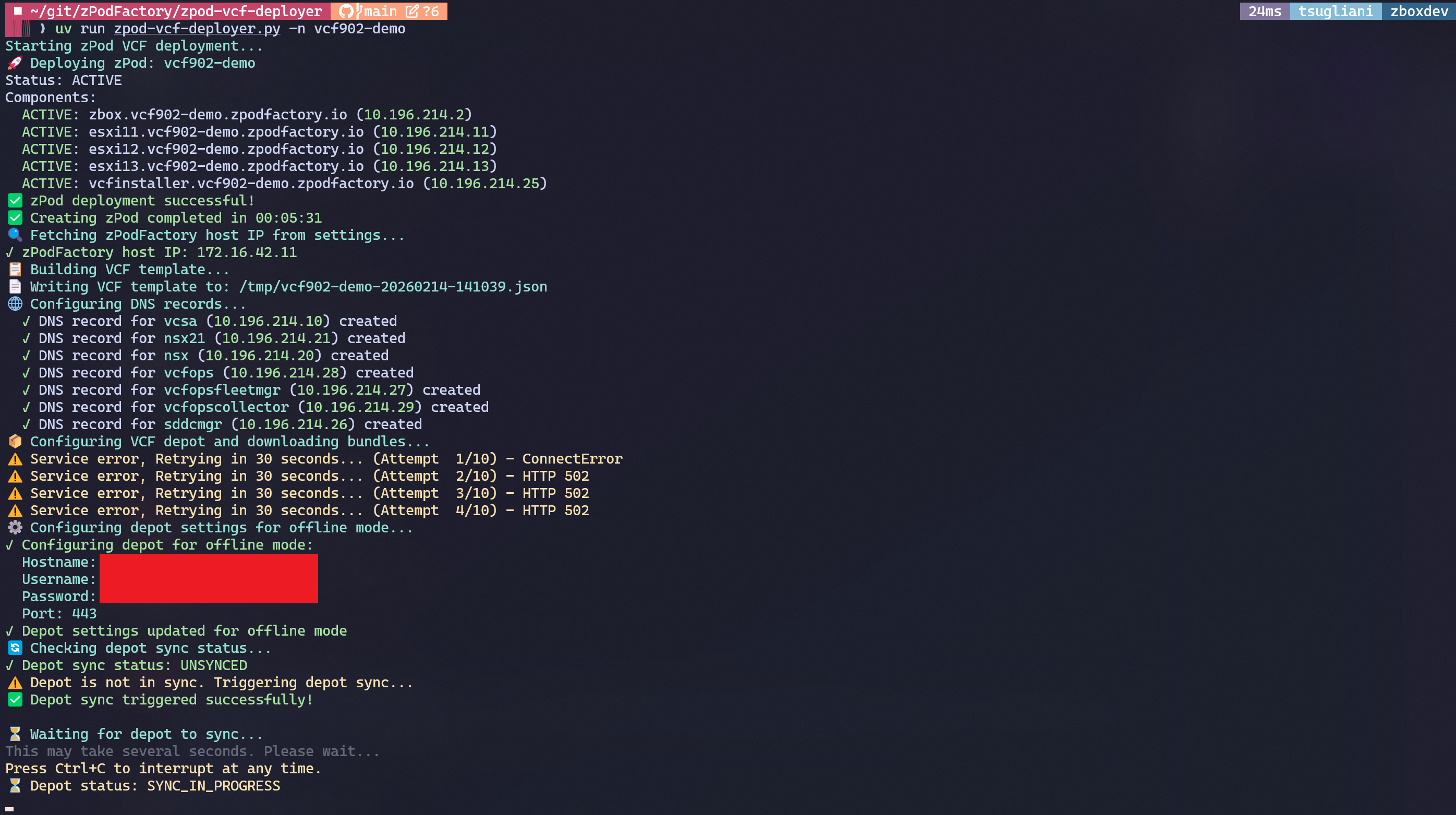
Deployment initialization
zPod provisioning and early pipeline steps with live terminal output.
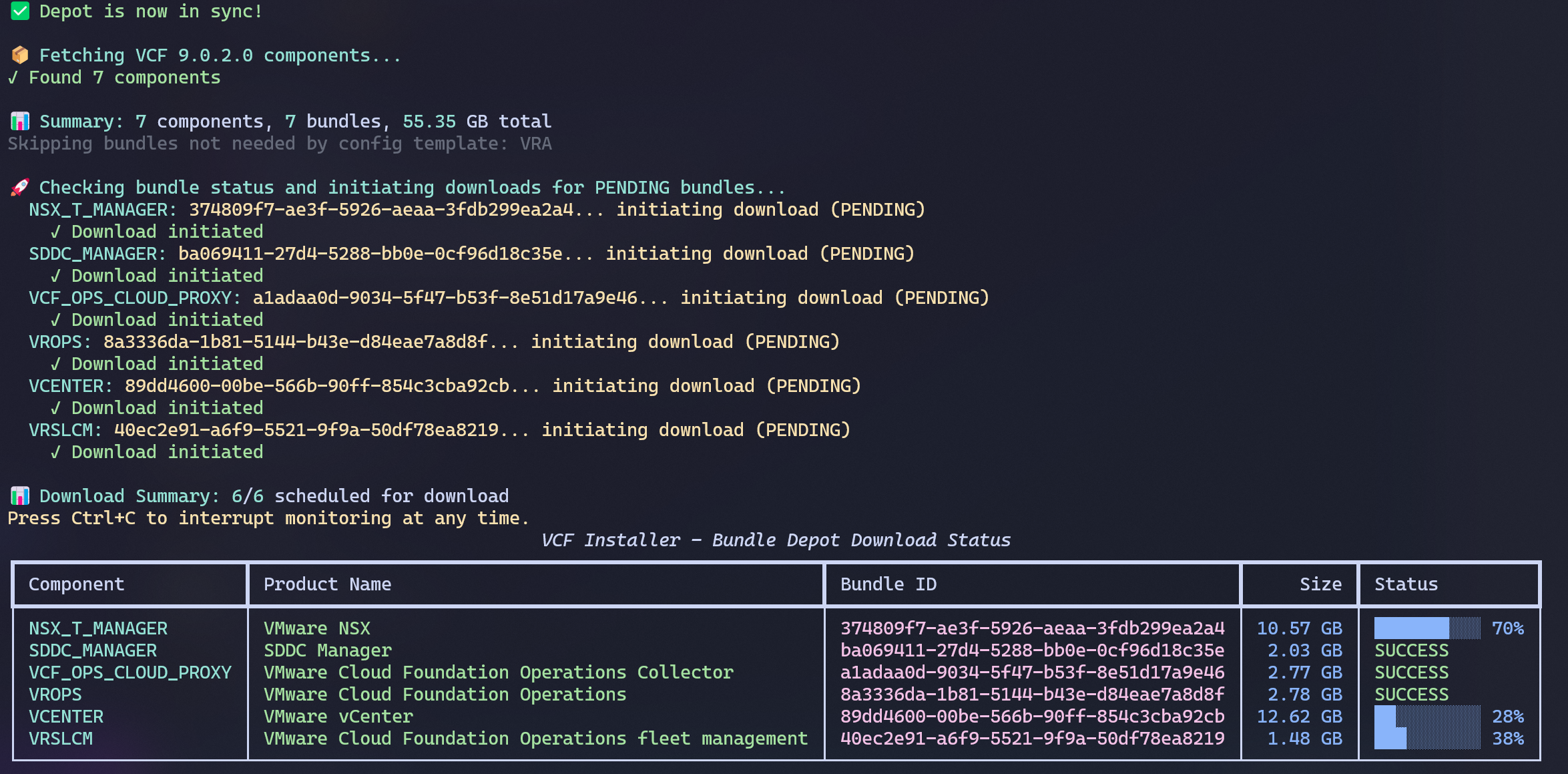
Offline depot and bundle downloads
Depot configuration on the VCF Installer and bundle download progress.
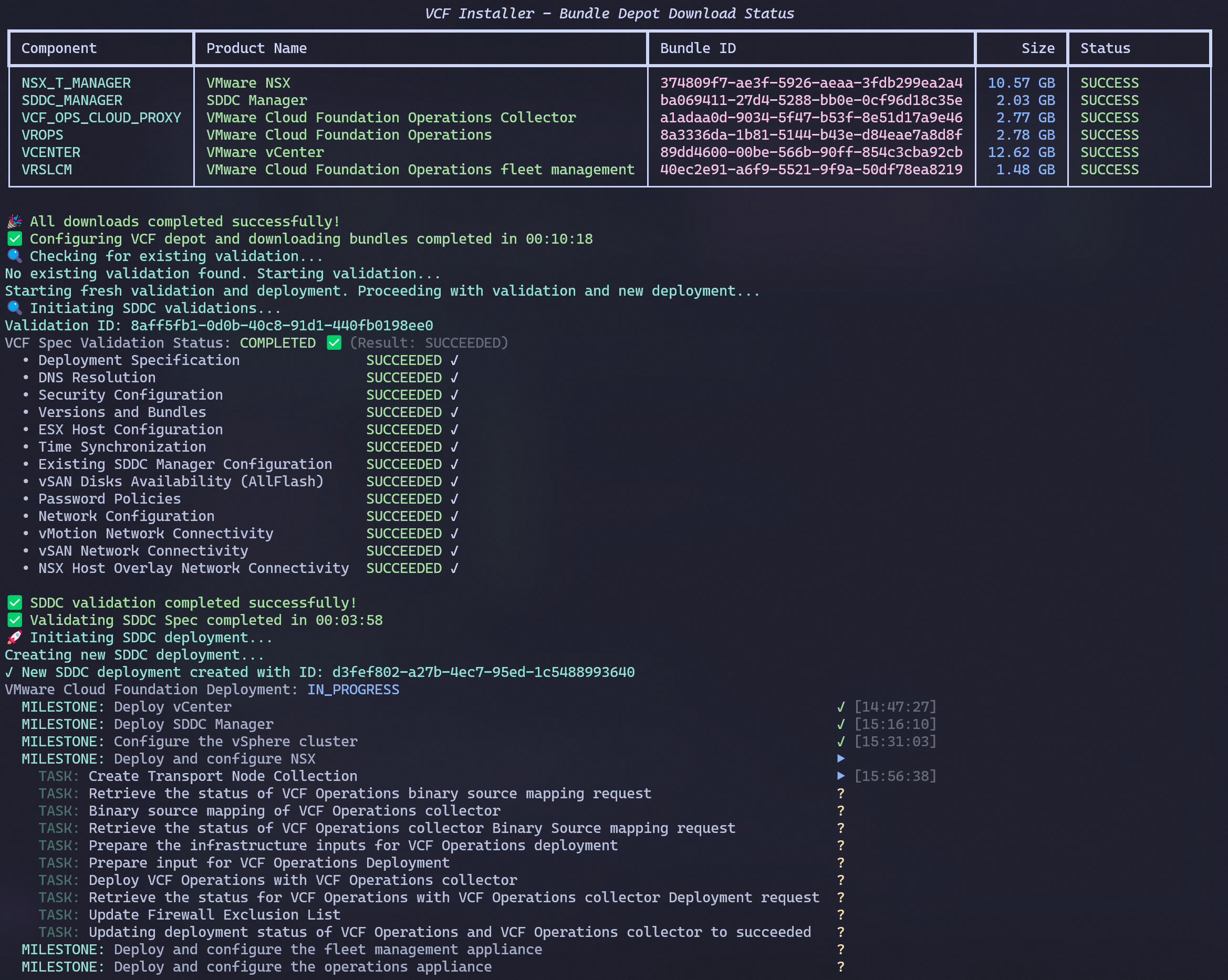
SDDC deployment progress
Global milestones and task status during SDDC deployment.
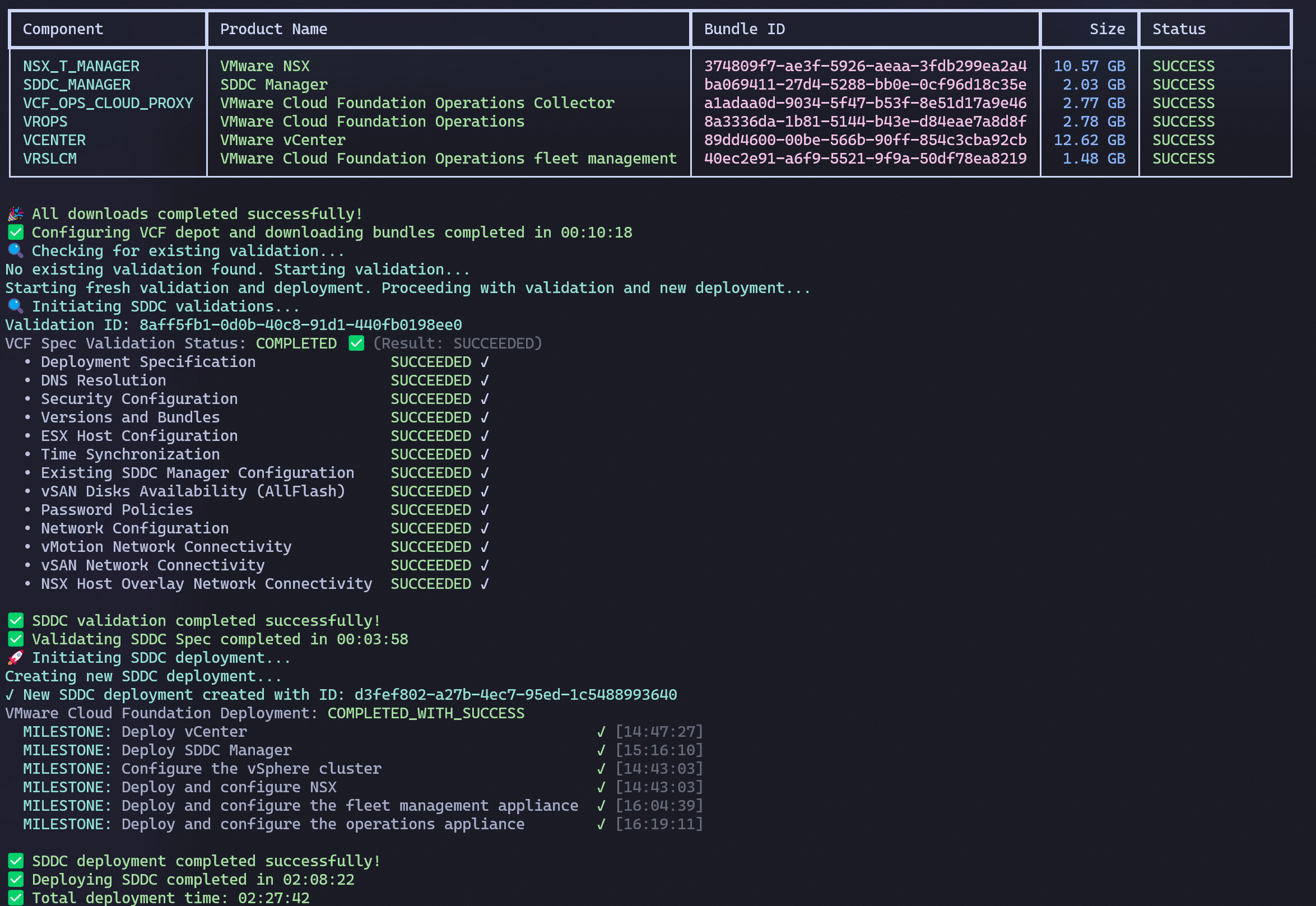
Deployment complete
Successful completion summary with per-step timings.
Screencast
Full terminal recording of an end-to-end run (zPod provision through SDDC deploy). Press play in the player below, or open on asciinema.org.
VCF 9.1+ depot mode
VCF 9.1 and later require an offline depot — Broadcom’s new activation model replaces the online depot used on 9.0.x. The deployer rejects --depot-mode online when a 9.1+ template is selected. See the project README for offline depot setup (doc-vcf-offlinedepot).
Profiles and templates
VCF deployments need a zPodFactory profile aligned with the VCF JSON template (host count, ESXi version, vcfinstaller component). Example profile shape:
zcore-*— core appliance (DNS, routing, NFS); legacy profiles may still usezbox-*esxi-*— one or more nested ESXi hosts (CPU, memory, vNICs, vDisks per host)vcfinstaller-*— VCF Installer / SDDC Manager appliance
Shipped templates under config/ in the repository cover common 3- and 4-host layouts for VCF 9.0.0.0 through 9.1.x (GA-pinned and -latest variants). GA templates pin full build-qualified component versions from the depot; -latest templates omit per-component versions so the installer picks the newest available (9.1+ only for express patches at bring-up).
Configure defaults once in .env (API URL, token, endpoint, profile, template path, depot settings), then deploy with:
Prerequisites
- uv on a workstation with API access to zPodFactory
- zPodFactory instance with components enabled for your VCF profile (ESXi,
vcfinstaller, etc.) - Broadcom download token for online depot (VCF 9.0.x), or an offline VCF depot server for 9.1+
- Matching profile and template for your target VCF release and host count
Dependencies are declared inline (PEP 723); uv run installs them automatically — no manual virtualenv.
Related documentation
- Repository (full usage, env vars, CLI reference): github.com/zPodFactory/zpod-vcf-deployer
- Config scripts — in-engine hooks for zPod/component lifecycle (complementary, not a substitute for VCF Installer automation)
- Manage profiles — how zPodFactory profiles define the L1 stack
- Broadcom download token — online depot token for VCF 9.0.x